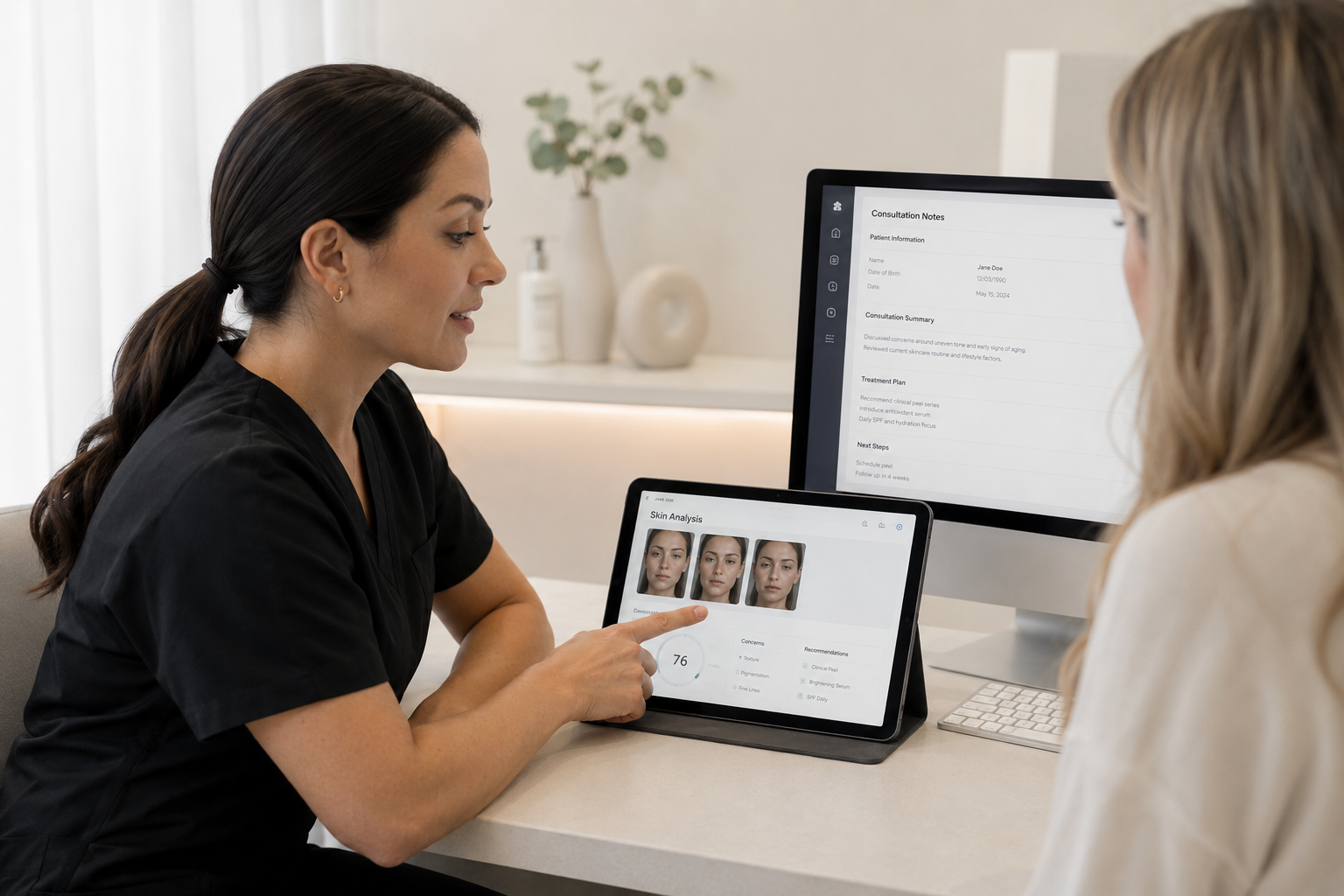
Artificial intelligence (AI) is rapidly moving from a future concept to an everyday reality within aesthetic practice.
From consultation support tools and automated communication systems to skin analysis platforms and AI generated treatment recommendations, clinics are increasingly integrating AI into patient journeys and operational workflows. In many cases, practitioners may already be using AI through existing software systems without fully recognising it.
But while much of the conversation around AI focuses on efficiency and innovation, there is another side to the discussion that practitioners cannot afford to ignore: risk, liability, insurance exposure and the growing issue of AI related risk in aesthetics.
AI is not only reshaping how clinics operate, but also influencing how patients research practitioners, form expectations, and pursue complaints when outcomes fall short.
As aesthetics business consultant and Aesthetics AI founder Ron Myers explained in a recent episode of the Aesthetics Business Cast, many clinics are already using AI without necessarily thinking of it that way. “People probably don’t even realise they’re using AI,” he says. “It could already be built into a CRM system, a chatbot or an automated response tool.”
The key issue is no longer whether AI is entering aesthetics. It already has.
The more important question is: who is responsible when AI gets it wrong?
Many people still associate AI with marketing or content creation, but its role in aesthetics is becoming far broader than that.
AI supported systems are increasingly being used to assist with patient screening, consultation support, treatment planning, skin analysis, risk scoring and automated communication. Some clinics are also using AI generated consultation notes, transcription tools and workflow automation systems to reduce administrative burden and improve efficiency.
In simple terms, AI supported decision making refers to systems that assist practitioners by analysing information, identifying patterns or generating recommendations.
Myers describes AI at its simplest as “a tool that can process information, identify patterns and generate responses from existing datasets far quicker than someone working manually.”
Importantly, these systems are designed to support decision making rather than replace it. AI may highlight possible risks, suggest treatments or organise information, but it does not understand patient context, exercise clinical judgement or hold professional accountability.
That distinction is critical from both a legal and insurance perspective.
One of the biggest misconceptions surrounding AI is that it somehow reduces professional responsibility.
It does not.
From a legal and regulatory perspective, practitioners remain responsible for all decisions made during patient assessment, consultation and treatment planning regardless of whether AI tools were involved.
AI cannot hold liability. It cannot be sued. And it cannot be insured in the same way a practitioner or clinic can.
“At the end of the day, AI doesn’t have the indemnity – the clinic does,” says Myers. “People can start to absolve responsibility to systems and processes that AI may handle without fully understanding or overseeing what those systems are actually doing.”
That is where risk begins to shift. As AI becomes more involved in consultation support, treatment planning and patient communication, clinics may face increasing insurance risk around AI supported decision making if appropriate oversight and governance are not maintained.
The more AI becomes embedded within workflows, communication systems and treatment planning, the more important human oversight becomes. If a complaint or claim arises, the focus is likely to remain on the practitioner’s actions, judgment, and governance processes rather than the technology itself.
This is particularly important because legal frameworks around AI liability in UK healthcare are still evolving. Courts currently have limited precedent for handling disputes involving AI supported clinical decision making, meaning responsibility may become increasingly complex where software providers, clinics and practitioners all play a role.
AI is often promoted as a way to improve consistency, reduce inefficiency and streamline patient communication. In many cases, it can genuinely support clinics in doing exactly that.
But it also introduces entirely new categories of risk.
One of the most widely discussed concerns is the risk of “hallucinations”, where AI systems generate inaccurate, misleading or entirely fabricated information that appears convincing. In a clinical setting, even small inaccuracies can have significant consequences.
For example, an AI assisted skin analysis system could incorrectly identify a condition as suitable for cosmetic treatment when further medical assessment was actually required. An automated aftercare system could send incomplete or overly generic advice. AI generated consultation notes may contain inaccuracies or omissions that later become problematic during a complaint investigation.
Even seemingly lower risk applications such as imaging and facial simulation tools can alter patient expectations in ways clinics may struggle to manage.
Myers believes this is an area practitioners need to approach carefully. “A lot of practitioners are uncomfortable with this technology because it can set expectations they can’t necessarily deliver,” he explains. “Particularly in aesthetics, outcomes can vary significantly from patient to patient.”
This becomes especially relevant as AI generated imaging becomes increasingly sophisticated and accessible. If patients begin interpreting digitally generated outcomes as guarantees rather than illustrations, dissatisfaction and disputes may become more likely.
AI is also changing how patients choose clinics in the first place.
Patients are no longer simply typing “Botox near me” into search engines. Increasingly, they are asking AI powered tools detailed questions around expertise, complications, safety and outcomes. According to Myers, AI systems are already beginning to evaluate clinics based on the depth and quality of their information rather than just paid advertising visibility.
“AI is trying to put patients in touch with the best person for them rather than simply the cheapest,” he says. “It’s looking at the depth of information, the reviews, the quality of content and evidence of expertise.”
This may ultimately reward clinics with strong governance, education and patient communication processes. But it also means scrutiny around claims, outcomes and reputation may intensify.
From an insurance perspective, AI does not remove risk, but it does reshape it.
Professional indemnity exposure may increase where AI tools influence patient assessment, treatment planning or communication without appropriate oversight and documentation. This evolving area of professional indemnity risk linked to AI is becoming increasingly relevant as clinics adopt more automated systems and AI supported workflows.
Insurers are increasingly interested in understanding:
As AI becomes more integrated into software systems and clinic operations, there are also growing grey areas around causation and accountability.
If a treatment decision was influenced by an AI recommendation, who ultimately carries responsibility? If automated systems contribute to poor communication or unrealistic expectations, how is liability assessed?
These are still developing areas legally and regulatorily. As AI becomes more embedded within patient care pathways, it is likely to become an increasingly important consideration within medical malpractice claims and disputes in UK aesthetics.
What is clear, however, is that practitioners who rely heavily on automation without understanding or supervising the process may increase their exposure to complaints and claims.
Hamilton Fraser has also seen broader shifts in the nature of complaints themselves. Patients now have access to increasingly sophisticated information tools, including AI generated complaint drafting and legal style correspondence.
As Eddie Hooker, CEO of Hamilton Fraser, noted during the podcast discussion, complaints increasingly arrive “like a lawyer’s written them, because everyone’s now a lawyer.”
This changing landscape makes robust consultation processes, accurate documentation and strong governance more important than ever.
For most clinics, the safest approach is to treat AI as a support tool rather than an authority.
Used appropriately, AI can improve efficiency, consistency and workflow management. It can support communication, reduce administrative burden and help practitioners manage growing operational complexity.
But there must always be oversight. AI cannot be responsible for duty of care.
“There are lots of processes you can automate within a clinic,” says Myers, “but there has to be oversight around that. Clinics need to understand what is being automated, how it’s being automated, and make sure things aren’t happening without anyone understanding what’s going on.”
This applies particularly to consultation notes, patient communication and treatment related information.
Myers believes AI assisted consultation recording and note generation could become one of the most valuable applications in aesthetics, provided clinics maintain appropriate safeguards. “The first benefit is having an accurate record of what was actually said during the consultation,” he explains. “But there still needs to be oversight to make sure information is accurate before anything is sent out or added to the patient record.”
Good governance now means more than simply keeping records. Clinics should also be considering:
Without structure and policies in place, informal AI adoption can quickly lead to inconsistencies and increased exposure.
As AI adoption increases, practitioners should review how these technologies may affect their insurance arrangements.
This includes checking:
Practitioners should also be transparent with insurers about the types of AI supported tools being used within the business, particularly where those tools influence clinical workflows or patient communication.
At present, not all professional indemnity policies explicitly address AI related exposures. However, this is likely to evolve as claims patterns develop and regulation becomes clearer.
Good documentation, strong oversight and clear governance remain some of the most important safeguards from both a patient safety and insurance perspective.
Practitioners concerned about complaints and claims management may also find it helpful to review:
Further guidance and resources are available via the Hamilton Fraser content hub.
AI is unlikely to remain a separate “technology trend” for long. Over time, it will probably become part of the everyday infrastructure of aesthetic practice in much the same way as online booking systems, CRM platforms and digital imaging already have.
Myers believes the biggest mistake clinic owners can make is avoiding the conversation altogether.
“The key thing for clinic owners is not to be afraid of it,” he says. “Start engaging with it, understand it, and focus on how it can support better communication, better documentation and better patient processes.”
At the same time, regulation is still catching up. Governments, insurers, regulators and professional bodies are all now grappling with questions around transparency, accountability and safe use of AI within healthcare environments.
That uncertainty is unlikely to disappear overnight.
But while the technology may evolve rapidly, the fundamentals of safe practice remain unchanged: good clinical judgement, honest communication, robust documentation and patient first care.
AI may support aesthetic practice, but it does not replace professional responsibility.
To find out how Hamilton Fraser can support evolving risks in aesthetic practice, get in touch with our specialist team on 0800 63 43 881 or get an online quote today.